

On International Women’s Day, we celebrate the powerful voices of the participants, facilitators and team members of the First Nations Executive Education (FNEE). Through their commitment, they shape and promote women’s leadership, while carrying with them the challenges, resilience and legacy of those who came before them.
Through the 7 cohorts of our Women Leadership program, we have trained more than 180 women from 9 Nations, who all share the same ambitions: to come together, rise together and take charge of their future, individually and collectively. In line with the United Nations’ 2025 theme for 8 March, “For ALL women and girls: rights, equality and empowerment”, FNEE presents the perspectives of 5 women with vision and heart.

Nadia Robertson and Brigitte Skeene (respectively 1st and 4th from left), at the gratuation ceremony in November 2024, with the 5th cohort of the Women Leadership program.
Intergenerational Women’s Leadership: honouring the past
Brigitte Skeene, Innu from Mashteuiatsh and academic co-lead of the FNEE Women Leadership program, humbly states that every step taken by Indigenous women from one generation to the next is a victory for the future: “women leaders before us stood up, broke down barriers and created opportunities in contexts far more difficult than ours. I feel an immense sense of gratitude and responsibility: to honour their struggle by making sure they didn’t fight in vain.”
Tiohenta Lahache-McComber, Kanien’kehà:ka from Kahnawake and recruitment manager at FNEE, also feels a deep sense of connection to be part of such a legacy, noting that “our women have always led, we continue to lead now and will continue to lead into the future.“
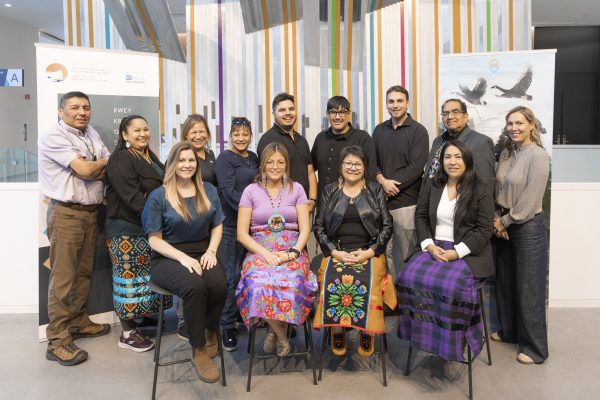
Audrey Ringuette (standing, far right), with her cohort from the EDPN Entrepreneurship programme.
Driven by the same inspiration, Audrey Ringuette, Innu and participant in FNEE's Entrepreneurship program, says: "Yesterday's leaders are tomorrow's leaders! For me, intergenerational female leadership represents the passing on and legacy of knowledge, the diversity of perspectives and the solidarity between women. It's an invaluable asset! "
Facilitator Carling Sioui, the daughter of a Wendat father and an Armenian mother, also shares a vision of female leadership based on solidarity: "Every generation has a mission for the next. It often involves a quest for liberation and a better life. Is this not the goal for all? Both of my cultures come from matrilineal traditions. Women are seen as leaders of the community, educating and elevating all their members. They manage many aspects and ensure equilibrium. None of us are perfect, but it is through our unity that we can build safe spaces for all to thrive in. Our diversity reflects the endless possibilities we can bring into the world."
On a more personal note, Nadia Robertson, Micmac from Gespeg and co-creator of FNEE's Women Leadership program, pays tribute to "all the strong women in my life: my grandmothers, my mother and my niece. They are my roots, models of strength and inspiration who never gave up, even in the face of the greatest trials. They are the ones who forged the woman I am today and all those who will come tomorrow. It is for them, and for all future generations, that we will continue to support women in their desire to shine."
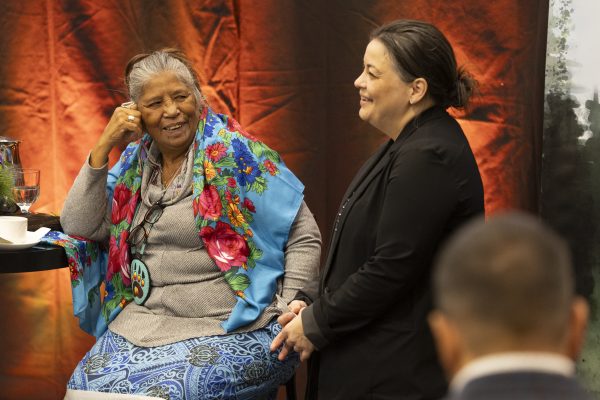
Elder Sedalia Fazio and Tiohenta Lahache-McComber, at the 3rd Anniversary of the FNEE, 14 November 2024.
A compass for the future
For the 5 women, rising together is definitely the key. As Brigitte Skeene illustrates: ''Indigenous women bring a unique approach to leadership, rooted in listening, collaboration and a long-term vision. More than ever, we need leadership that brings people together, gives them meaning and builds lasting solutions. When I think of the next generation of female leaders, I'm filled with hope. They are bold, assertive and aware of their impact." Tiohenta Lahache-McComber adds that: ''women leaders will continue to build on the knowledge and experiences shared by those who led before us, those we lead with today, and those who will lead after us. A generation with the resilience to continue to lead into the future. It looks bright."
Carling Sioui concludes with hope: "We live in a world built on hierarchy and competition, making us think we need to be ahead of others in order to be successful. I believe that success is based on collective wellbeing. This is what many matriarchal societies go by. The collective is more important than the individual, because we are nothing without each other. I hope the next generation of women leaders will help us all get back to a more balanced lifestyle."
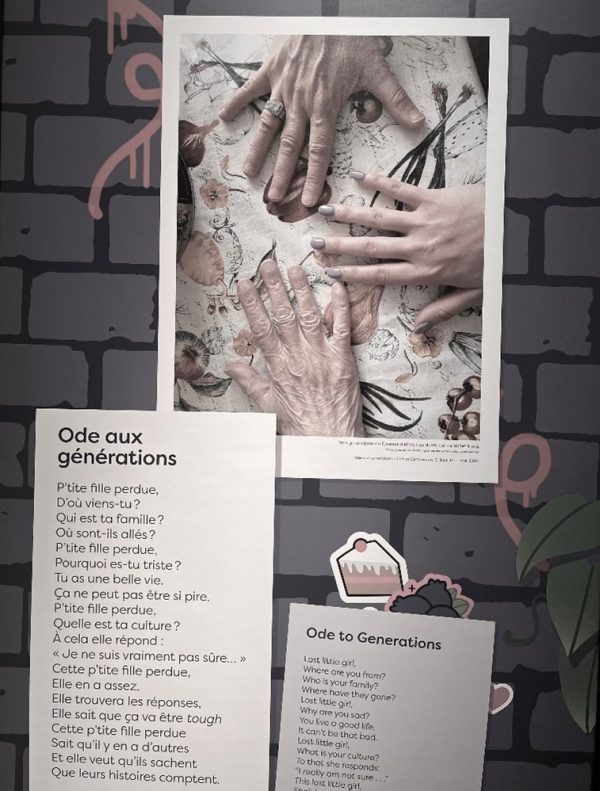
Ode to Generations
Lost little girl,
Where are your from?
Who is your family?
Where have they gone?
Lost little girl,
Why are you sad?
You have a good life,
It can’t be that bad.
Lost little girl,
What is your culture?
To that she responds,
‘I really am not sure’
This lost little girl,
She has had enough.
She will find the answers.
She knows it will be tough.
This lost little girl,
Knows there are more like her.
And she wants them to know,
That their stories matter.
Carling Sioui’s poem ‘Ode to Generations’, shown here with the hands of 3 generations of women (her mother, her grandmother and herself), is featured in the exhibition Still Here! Indigenous Peoples’ Voices in Montréal, at the Centre des mémoires montréalaises, until 26 March 2025.

